
Content marketing is a strategic approach to attracting and retaining a clearly defined audience by consistently creating and distributing useful, relevant content that helps people solve problems, answer questions, evaluate options, or achieve specific goals.
At its best, content marketing is not simply “publishing content.” It is a business system that connects audience needs, useful information, distribution, customer relationships, and measurable business outcomes.
The Content Marketing Institute describes content marketing as a strategic approach based on creating and distributing valuable, relevant, and consistent content to attract and retain a defined audience and ultimately drive profitable customer action.
However, simply producing more articles is not a sufficient strategy. Search is increasingly incorporating AI-generated experiences, audiences consume information across multiple channels, and businesses face more competition for attention. Google says its AI features continue to rely on foundational SEO practices and people-first content rather than requiring a separate “AI optimization” system.
That means beginners should focus less on publishing volume and more on usefulness, originality, evidence, expertise, distribution, and measurable outcomes.
This guide explains how content marketing works, the major formats, its relationship with SEO and social media, how to create a strategy from scratch, what to measure, how to use AI responsibly, and how to build a sustainable content system in 2026.
Written by Mukthar Salam
Last updated: September 2026
Editorial note: Content marketing practices, search features, software capabilities, and platform policies change over time. Product features, prices, certifications, and other time-sensitive details should be checked against the provider’s current documentation before publication or implementation.
What Is Content Marketing?

Content marketing is the planned creation and distribution of useful information for a specific audience with the purpose of building attention, trust, engagement, leads, customers, and long-term business value.
The important distinction is that not every piece of marketing content is content marketing.
A product page, advertisement, sales brochure, or promotional email can certainly contain content. But content marketing generally emphasizes building an audience relationship through useful information rather than relying exclusively on direct promotional messages. The distinction between “content” and the broader strategic practice of content marketing is also emphasized by the Content Marketing Institute.
For example, suppose you sell accounting software to small businesses.
A purely promotional approach might repeatedly tell people “Buy our accounting software today.”
A content marketing approach could instead create:
- A guide to creating a small-business budget
- A tutorial on tracking expenses
- An article comparing spreadsheets with accounting software
- A cash-flow forecasting template
- A video demonstrating invoice creation
- An email series explaining bookkeeping fundamentals
- A case study about a customer’s implementation
- A checklist for preparing financial records
These resources can help people before they are ready to buy. That is one of the central ideas behind content marketing: Solve a relevant problem first; create the commercial opportunity second.
Content marketing can include:
- Blog articles
- Guides
- Tutorials
- Videos
- Podcasts
- Newsletters
- Ebooks
- Case studies
- Whitepapers
- Research reports
- Webinars
- Infographics
- Calculators
- Templates
- Checklists
- Social media content
- User-generated content
- Interactive tools
The correct format depends on the audience, subject, objective, resources, and distribution channel.
How Does Content Marketing Work?
A simple content marketing system can be represented as:
Audience problem → Useful content → Discovery → Engagement → Trust → Action → Customer → Retention
Consider someone searching for: “How to start an online store.”
They discover your educational guide through search. The article answers their questions and provides a useful checklist. At the end, you offer a more detailed e-commerce template in exchange for an email address.
The visitor becomes a subscriber. Over time, you send educational emails, product comparisons, tutorials, and case studies. Eventually, the subscriber may purchase your ecommerce software, service, course, or product.
The first article did not necessarily generate an immediate sale. Instead, it began the relationship.
This is why content marketing should be evaluated as a customer journey, not simply as a collection of individual articles.
Content Marketing Funnel
A practical content funnel can be divided into four broad stages:
- Awareness
- Consideration
- Conversion
- Retention
These stages are useful for planning, although real customer journeys are not always linear.
1. Awareness
At the awareness stage, people are discovering a problem, asking questions, or exploring an opportunity.
They may not know your company.
Useful content includes:
- Beginner guides
- Definitions
- Educational videos
- How-to articles
- Infographics
- Podcasts
- Research
- Social posts
- Introductory tutorials
For example: “What Is Email Marketing?”
Someone searching for that question may not yet be ready to purchase email marketing software. Your objective is to provide a useful explanation and establish an initial relationship.
2. Consideration
At this stage, the audience understands the problem and is investigating potential solutions.
They may search for:
- Product comparisons
- Alternatives
- Reviews
- Pricing
- Features
- Tutorials
- Case studies
- Implementation guides
- Best practices
For example: “Email marketing software for small businesses.”
This search indicates a different level of commercial consideration than: “What is email marketing?”
Your content should therefore become more specific as the prospect moves closer to a decision.
3. Conversion
Conversion content helps prospects overcome uncertainty and take a meaningful business action.
Depending on the business, conversion might mean:
- Purchasing a product
- Booking a consultation
- Starting a trial
- Requesting a quotation
- Registering for a webinar
- Downloading a resource
- Opening an account
- Subscribing to a paid service
Useful conversion content includes:
- Product demonstrations
- Comparison pages
- Case studies
- Pricing explanations
- Product FAQs
- Implementation guides
- Customer testimonials
- ROI calculators
- Free trials
The objective is not simply to say “buy now.” It is to reduce uncertainty and make the next decision easier.
4. Retention
Content marketing should continue after someone becomes a customer.
Retention content can include:
- Onboarding emails
- Tutorials
- Knowledge-base articles
- Advanced guides
- Product updates
- Troubleshooting resources
- Customer newsletters
- Training videos
- Community content
This can help customers understand and use what they purchased. It also creates opportunities for repeat purchases, upgrades, referrals, reviews, and stronger customer relationships.
Why Is Content Marketing Important?
Content marketing can help a business build an audience without making every interaction dependent on direct advertising.
- useful article can answer a question.
- video can demonstrate a product.
- case study can address uncertainty.
- newsletter can maintain an ongoing relationship.
- research report can demonstrate expertise.
- template can help someone complete a task.
When these assets are connected, they can form a broader customer acquisition and education system.
However, content marketing should not be presented as automatically successful or inherently inexpensive.
Creating high-quality content requires:
- Research
- Subject expertise
- Writing
- Editing
- Design
- Technology
- Distribution
- Measurement
- Maintenance
The business case therefore depends on whether the content produces enough value to justify those resources.
Benefits of Content Marketing
A well-designed program can contribute to several business objectives.
1. Brand Awareness
Useful content can introduce your organization to people who may not have encountered your brand otherwise.
2. Audience Education
Content can explain complex products, services, processes, and concepts before a prospect contacts the business.
3. Lead Generation
Guides, templates, newsletters, webinars, and other resources can encourage appropriate visitors to become leads.
4. Search Visibility
Useful content can target relevant search queries and create opportunities to receive organic traffic.
Google’s guidance emphasizes original, comprehensive, people-first content rather than content created primarily to manipulate search rankings.
5. Sales Support
Sales teams can use case studies, research, tutorials, comparison resources, and FAQs to answer customer questions.
6. Customer Retention
Educational content can help existing customers get more value from products and services.
7. Reusable Marketing Assets
A strong research report, guide, or video can become the foundation for multiple related pieces of content.
8. Audience Insight
Comments, questions, search queries, support conversations, and content performance can reveal what your audience actually cares about.
9. Authority
Consistently demonstrating genuine knowledge can strengthen a brand’s reputation within a particular subject area.
10. Multi-Channel Distribution
A substantial piece of content can sometimes be adapted into several formats without simply duplicating it word for word.
Content Marketing vs. Digital Marketing
These terms are related but not interchangeable. Digital marketing is the broader category.
It can include:
- SEO
- Content marketing
- Email marketing
- Social media marketing
- Paid advertising
- Affiliate marketing
- Influencer marketing
- Conversion optimization
- Online public relations
Content marketing is one component of the broader digital marketing ecosystem. For example, a business might use:
Content marketing → create an in-depth guide.
SEO → help people discover the guide through search.
Email marketing → distribute the guide to subscribers.
Social media → distribute short versions of its ideas.
Paid advertising → promote the guide to a relevant audience.
The channels support one another, but they have different functions.
Content Marketing vs. SEO
SEO and content marketing overlap heavily, but they are not the same discipline.
SEO focuses on improving the ability of web pages and other resources to be discovered through search.
Content marketing focuses on creating and distributing useful content for a defined audience and achieving business objectives.
SEO can help people discover your content. Content gives the search engine something useful to discover and users something worth consuming.
Google’s current documentation also makes clear that its AI search experiences continue to rely on foundational SEO practices, including crawlability, internal links, useful textual content, good page experience, and people-first content.
Keyword Research Is Not the Strategy
Keyword research can be useful, but it should not become the entire content strategy. A keyword represents a search phrase. A topic represents the broader problem or subject behind that search.
For example:
Keyword: “small business cash flow template”
Underlying problem: The business owner needs a practical way to monitor incoming and outgoing cash.
That broader understanding could produce:
- cash-flow guide
- downloadable template
- tutorial
- forecasting article
- video
- An FAQ
- case study
- An email sequence
This creates a more useful content ecosystem than producing one article simply because a keyword tool displayed a particular phrase.
Understanding Search Intent
Search intent is the reason behind a search.
Four practical categories are:
Informational intent
The person wants to learn something.
Examples:
- What is content marketing?
- What is an AI agent?
- How does email marketing work?
Commercial investigation
The person is evaluating options.
Examples:
- Best email marketing software
- Shopify alternatives
- Web hosting comparison
Transactional intent
The person appears ready to take an action.
Examples:
- Buy accounting software
- Start email marketing trial
- Purchase domain name
Navigational intent
The person is trying to reach a specific website, brand, or resource. Understanding intent prevents a common mistake: creating content that answers the wrong question.
People-First Content in 2026
One of the most important principles for content marketers is that search optimization should not replace usefulness.
Google’s guidance asks publishers to consider whether content provides original information, research, analysis, or substantial coverage and whether it demonstrates first-hand expertise and depth of knowledge.
For every article, ask:
- Who is this for?
- What problem does it solve?
- Can I add original examples?
- What information is missing from competing resources?
- Can I provide evidence?
- What does the reader need to know?
- Can I explain the subject more clearly?
- Can I give the reader a practical next step?
This is especially important in 2026 because publishing large quantities of generic content is not a sustainable substitute for expertise.
Google’s spam policies specifically identify scaled content abuse as a problem when large quantities of unoriginal content are produced primarily to manipulate search rankings, regardless of whether humans or generative AI produced it.
Types and Formats of Content Marketing
There is no single universal list of content formats. Instead, choose formats according to what your audience needs.
Blog Articles
Useful for:
- Educational guides
- Tutorials
- Comparisons
- Definitions
- Research
- Opinion supported by evidence
- Problem-solving content
Video
Useful for:
- Demonstrations
- Tutorials
- Interviews
- Product walkthroughs
- Explanations
- Short educational content
Useful for:
- Newsletters
- Educational sequences
- Product updates
- Nurturing
- Customer education
- Offers
Podcasts
Useful for:
- Interviews
- Long-form discussions
- Expert commentary
- Storytelling
- Educational conversations
Ebooks and Guides
Useful for:
- Comprehensive education
- Lead generation
- Frameworks
- Reference resources
Case Studies
Useful for showing how a real customer, organization, or project addressed a particular problem.
Strong case studies should provide enough detail to make the example credible rather than simply saying: “Customer X got amazing results.”
Explain:
- starting problem
- situation
- approach
- implementation
- obstacles
- measurable outcome
- Important limitations or context
Original Research
Research can be especially valuable because it gives other publishers something to reference.
Examples include:
- Surveys
- Industry studies
- Benchmark reports
- Internal datasets
- Original experiments
- Market analysis
Interactive Content
Examples include:
- Calculators
- Quizzes
- Assessments
- Configurators
- Planning tools
- Templates
Interactive content can provide utility that a conventional article cannot.
How to Build a Content Marketing Strategy in 2026
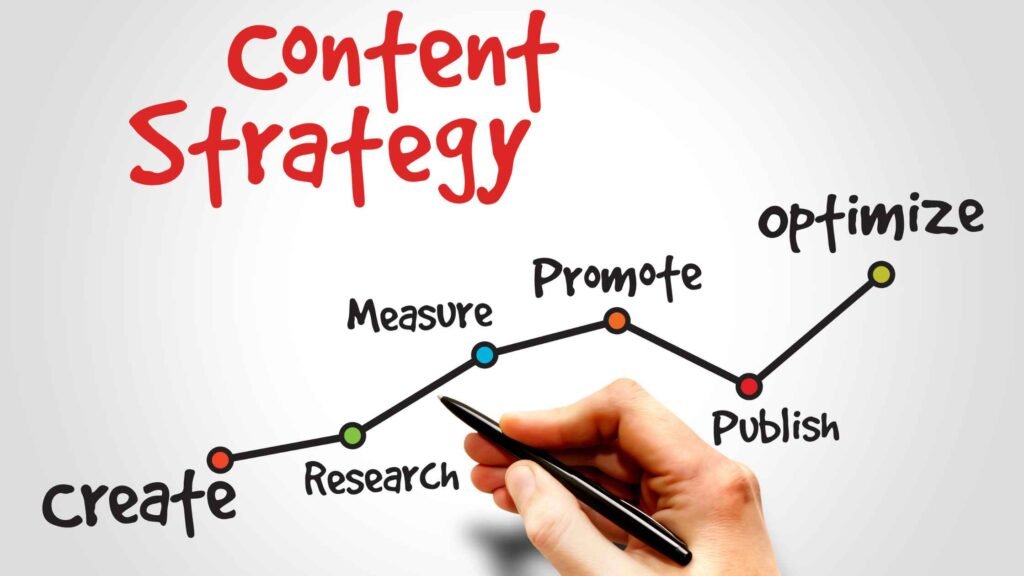
The following framework turns content marketing from an abstract concept into an operating process.
Step 1: Define the Business Objective
Start with the business outcome.
Possible objectives include:
- Generate qualified leads
- Increase organic traffic
- Increase product sales
- Grow an email audience
- Reduce customer support demand
- Improve customer retention
- Build authority in a niche
- Support a new product launch
Avoid vague objectives such as: “We need more content.”
Instead: “We want content to generate 100 qualified leads per month.”
The exact target should be realistic for the business and measured over a defined period.
Step 2: Define Your Audience
Do not try to create content for everyone.
Identify:
- What they are trying to accomplish
- What problems they experience
- Who they are
- What questions they ask
- What alternatives they consider
- Which information they trust
- What prevents them from taking action
Useful research sources include:
- Customer interviews
- Sales conversations
- Support tickets
- Product reviews
- Surveys
- Community discussions
- Search queries
- Website analytics
- Competitor research
The objective is to discover real information needs.
Step 3: Identify Audience Problems
Create a simple matrix:
| Problem | Question | Desired outcome | Content opportunity |
| Poor cash flow visibility | How do I track cash flow? | Better financial control | Guide + template |
| Low website traffic | How do I attract visitors? | More qualified traffic | SEO guide |
| Poor email engagement | Why aren’t subscribers clicking? | Better engagement | Email optimization guide |
| High customer churn | Why are customers leaving? | Higher retention | Retention framework |
This approach is stronger than randomly brainstorming article titles.
Step 4: Build Topic Clusters
Organize related subjects into logical groups.
For example, a digital marketing website might have:
SEO
- Keyword research
- On-page SEO
- Technical SEO
- Internal linking
- Search intent
- Content optimization
Content Marketing
- Content strategy
- creation
- promotion
- Content calendars
- Repurposing
- Content measurement
Email Marketing
- Email list building
- copywriting
- Email automation
- Segmentation
- Deliverability
- Email analytics
This structure helps users navigate your website and creates opportunities for meaningful internal linking.
Step 5: Choose the Right Content Format
Ask:
What is the best format for solving this particular problem?
- technical process might require a tutorial.
- complicated comparison might require a table.
- financial calculation might benefit from a calculator.
- customer story might work better as a case study.
- An expert discussion may be better suited to video or audio.
- Do not select a format simply because it is currently popular.
- Select the format that communicates the information effectively.
Step 6: Create a Sustainable Content Calendar
Your calendar should be realistic.
Useful fields include:
| Field | Purpose |
| Topic | What will be published |
| Audience | Who it serves |
| Search intent | Why they need it |
| Format | Article, video, guide, etc. |
| Primary objective | Business purpose |
| Owner | Person responsible |
| Publication date | Schedule |
| Distribution channels | Where it will be promoted |
| CTA | Desired next action |
| Update date | Maintenance schedule |
Do not create a schedule that your team cannot maintain. For a small business, one excellent article per week may be more sustainable than seven weak articles.
Step 7: Research Before Writing
Authoritative content requires more than rewriting the first page of search results.
Research should include:
- Primary sources
- Government resources where relevant
- Official documentation
- Original research
- Industry organizations
- Expert interviews
- First-hand experience
- Credible data
- Relevant case studies
For technical or fast-changing subjects, verify information close to publication.
This is especially important for:
- Software features
- Prices
- Regulations
- Financial information
- AI capabilities
- Search policies
- Product specifications
Step 8: Create the Content
A strong article should have a clear information architecture.
A practical structure is:
H1 → introduction → direct answer → H2 sections → H3 subsections → examples → evidence → practical steps → FAQs → conclusion
Do not add sections simply to increase word count. Every section should answer a question, provide evidence, explain a concept, give an example, or help the reader take action.
Step 9: Add Original Value
This is one of the most important differences between ordinary content and authoritative content.
Add:
- Original examples
- First-hand observations
- Data
- Screenshots where appropriate
- Practical frameworks
- Calculations
- Expert commentary
- Case studies
- Comparisons
- Templates
- Checklists
- Decision criteria
- Clear explanations of limitations
Ask: “What does this article provide that a reader cannot easily get by reading five generic articles?”
That question should guide the entire editorial process.
Step 10: Optimize for Search Without Keyword Stuffing
Once the content is genuinely useful, optimize it.
Review:
- Page title
- H1
- H2/H3 headings
- URL
- Introduction
- Internal links
- Image descriptions
- Metadata
- Relevant terminology
- Content hierarchy
- Mobile experience
Google recommends clear, concise, and accurate page titles, while snippets may be generated from page content and sometimes from the meta description.
Do not force a keyword into every paragraph. Use natural variations and cover the subject comprehensively.
For this article, related terminology might include:
- content strategy
- content creation
- distribution
- content promotion
- SEO content
- audience research
- content calendar
- content formats
- performance
- content ROI
- content repurposing
Step 11: Build Meaningful Internal Links
Internal links should help the reader move to the next relevant resource.
For example, an article about content marketing might naturally link to:
- SEO strategy
- Email marketing
- Digital marketing
- Keyword research
- Website traffic
- Lead generation
- Customer retention
- AI tools for business
Avoid adding links simply because you want to increase the number of internal links. The anchor text should describe the destination naturally.
For example: “If you are building a broader digital marketing strategy, content should work alongside SEO, email, social media and other acquisition channels.”
That is more useful than: “Click here.”
Step 12: Publish With a Quality-Control Checklist
Before publication, review:
Accuracy
- Are facts correct?
- Are statistics sourced?
- Is product claim verified?
- Are dates current?
Editorial quality
- Is the article easy to understand?
- Are unnecessary sections removed?
- Are grammar and spelling correct?
- Is there repetition?
SEO
- Is the title descriptive?
- Is the URL clean?
- Are headings logical?
- Are internal links relevant?
- Is the page indexable?
User experience
- Is the article easy to scan?
- Are tables readable?
- Are images useful?
- Is the page mobile-friendly?
- Are important answers easy to find?
Trust
- Is the author identified where appropriate?
- Are important claims supported?
- Are commercial relationships disclosed?
- Is the article’s review date visible where appropriate?
Step 13: Distribute the Content
Publishing is only one part of the process.
Depending on your audience, distribution can include:
- Email newsletters
- YouTube
- TikTok
- Industry communities
- Partnerships
- Organic search
- Relevant outreach
- Paid promotion
The important principle is distribution with relevance.
Do not spam communities with links to your articles. Instead, contribute something useful and provide the resource when it genuinely helps.
Step 14: Repurpose Strong Content
Repurposing can increase the usefulness of a successful idea.
Suppose you publish: “Complete Guide to Email Marketing for Small Businesses.”
You could turn it into:
- A YouTube tutorial
- Five short videos
- A LinkedIn carousel
- An email newsletter
- A checklist
- Several social posts
- An infographic
- A downloadable PDF
- A webinar
Repurposing should not mean mechanically copying the same content everywhere.
Adapt the material to the format and audience.
Step 15: Measure and Improve
The final stage is continuous improvement.
The cycle becomes: Research → Plan → Create → Publish → Distribute → Measure → Improve → Repeat
This is more sustainable than treating every article as a one-time project.
How to Create High-Quality Content
Quality is not synonymous with word count. A useful 2,000-word guide can be more valuable than a 7,000-word article that repeats the same ideas.
Strong content should generally be:
- Accurate
- Relevant
- Original
- Practical
- Well organized
- Evidence-based where appropriate
- Easy to understand
- Appropriate for its audience
- Transparent about limitations
Use Examples
Examples make abstract concepts easier to understand.
Instead of saying: “Create audience-focused content.”
Show what that means for a software company, e-commerce store, consultant, or local business.
Explain Limitations
Authoritative content does not pretend that every tactic works for everyone.
Explain:
- When a strategy works
- What resources it requires
- When it may not work
- What risks exist
- What assumptions you’re making
This increases credibility.
Content Promotion Strategy
A strong distribution plan can be divided into three areas.
Owned Distribution
Channels you control:
- Website
- Email list
- Customer community
- App
- Knowledge base
Earned Distribution
Attention generated by others:
- Backlinks
- Mentions
- Reviews
- Media coverage
- Expert references
- Customer sharing
Paid Distribution
Channels where you pay for exposure:
- Search advertising
- Social advertising
- Sponsored content
- Display advertising
- Newsletter sponsorships
A balanced strategy does not necessarily require using all three.
Choose channels based on your audience and resources.
Social Media and Content Marketing
Social media can help distribute content, collect audience feedback, and develop community. But social media should not simply become a dumping ground for article links.
A better process is: Create useful resource → extract useful idea → adapt it for platform → start conversation → direct interested people to deeper resource
For example, a long article about customer retention could become:
- short educational video
- LinkedIn post
- carousel
- discussion question
- An email
- checklist
Choosing the Right Social Platform
You do not need to maintain every social account.
Consider:
- Your production capabilities
- Your industry
- Where your customers spend time
- Which formats they consume
- Your objectives
- Your available resources
A B2B software company may prioritize professional networks and long-form educational content. A visual ecommerce company may invest more heavily in short-form video and visual platforms.
The correct answer depends on the audience rather than a universal platform ranking.
How to Measure Content Marketing Performance
One of the biggest mistakes beginners make is measuring activity instead of outcomes. Publishing 20 articles is an activity. Generating 200 qualified leads from those articles is an outcome.
Your metrics should therefore connect to the business objective.
Website Traffic
Traffic tells you how many visitors arrive. But traffic alone does not prove business value.
A page receiving 50,000 visitors may produce fewer customers than a highly targeted page receiving 2,000 visitors.
Engagement
In Google Analytics 4, engagement rate represents the percentage of sessions classified as engaged sessions. Google defines an engaged session as one lasting longer than 10 seconds, containing a key event, or having two or more page or screen views.
Engagement metrics can include:
- Engagement rate
- Average engagement time
- Scroll behavior
- Video interactions
- Downloads
- Clicks
- Comments
- Shares
Interpret them according to the content type rather than using one metric as a universal quality score.
Leads
If lead generation is your objective, track:
- Lead volume
- Qualified leads
- Conversion rate
- Cost per lead
- Lead-to-customer rate
- Revenue generated
This tells you whether content is attracting the right people.
Conversions
A conversion could be:
- Purchase
- Signup
- Consultation
- Trial
- Download
- Registration
- Quote request
Define the conversion before publishing the content.
Content Marketing ROI
A simplified ROI formula is: ROI = (Revenue attributed to content − Content investment) ÷ Content investment × 100
For example: Suppose a business invests $5,000 in content production and distribution. If the business can reasonably attribute $15,000 in revenue to that content: ($15,000 − $5,000) ÷ $5,000 × 100 = 200%
However, attribution is often more complicated than this calculation suggests.
A customer might:
- Discover an article.
- Watch a video.
- Subscribe to an email list.
- Read a case study.
- Speak to sales.
- Purchase several weeks later.
Which content receives credit? There is no single answer for every business.
Consider tracking:
- First-touch conversions
- Last-touch conversions
- Assisted conversions
- Lead generation
- Sales
- Customer lifetime value
- Acquisition cost
- Revenue
- Retention
The right measurement model depends on your sales cycle and business model.
A Practical Content Performance Dashboard
A simple dashboard might look like this:
| Objective | Metrics |
| Brand awareness | Impressions, reach, branded searches |
| Organic growth | Organic clicks, impressions, indexed pages |
| Engagement | Engagement rate, time, interactions |
| Lead generation | Leads, qualified leads, conversion rate |
| Sales | Revenue, purchases, assisted conversions |
| Retention | Repeat purchases, retention, customer engagement |
| Efficiency | Cost per lead, content production cost, ROI |
Do not track dozens of metrics simply because analytics software provides them.
Track the numbers that help you make decisions.
How to Create Content Efficiently
A repeatable production system can reduce wasted effort.
1. Research
Identify the audience, problem, evidence, search intent, and competing resources.
2. Outline
Create the logical structure before writing.
3. Draft
Write the first version without obsessing over every sentence.
4. Fact-Check
Verify important claims.
5. Edit
Remove:
- Repetition
- Unsupported claims
- Weak introductions
- Unnecessary sections
- Generic statements
6. Add Original Value
Include examples, analysis, frameworks, data, experience, or useful resources.
7. Optimize
Review SEO, headings, links, images, metadata, and readability.
8. Add a CTA
Give the reader a relevant next step.
9. Publish
Complete the technical and editorial checks.
10. Promote
Distribute the content to relevant audiences.
11. Measure
Review results.
12. Update
Improve the resource as information changes.
Using AI for Content Marketing in 2026
AI can become a useful part of a content workflow.
It can assist with:
- Brainstorming
- Topic organization
- Outlining
- Summarization
- Editing
- Repurposing
- Research organization
- Content briefs
- Data classification
- Workflow automation
But there is an important distinction between using AI to improve the content process and using AI to mass-produce generic pages.
Google’s guidance states that appropriate AI use is not automatically against Search policies. The concern is using automation to generate content primarily to manipulate search rankings or producing large quantities of low-value, unoriginal content.
Google’s current AI-search guidance also emphasizes valuable, unique, non-commodity content and says there is no special markup or separate optimization requirement needed to appear in AI Overviews or AI Mode.
A sensible workflow is: AI assistance → human review → fact verification → original analysis → editing → publication
Do not assume that an AI-generated first draft is publication-ready. For important topics, especially financial, legal, medical, technical, or regulatory subjects, verify important claims against authoritative sources.
Content Marketing Mistakes Beginners Should Avoid
1. Publishing Without an Audience
If you do not know who the content is for, it becomes difficult to determine what information matters.
2. Writing Only About Your Product
Your audience has problems that exist before your product enters the conversation.
Address those problems.
3. Chasing Every Keyword
Keyword research should inform strategy, not replace it.
4. Publishing for Volume
More pages do not automatically create more value. Google specifically warns against scaled production of unoriginal content intended primarily to manipulate search rankings.
5. Copying Competitors
Competitor research is useful. Copying their structure and ideas without adding meaningful value is not a sustainable strategy.
6. Ignoring Distribution
A good resource still needs a way to reach its intended audience.
7. Ignoring Older Content
Some existing pages may be improved more efficiently than creating entirely new ones.
8. Measuring Vanity Metrics
Views and impressions can be useful, but they are not necessarily business outcomes.
9. Overusing AI
AI can accelerate production while still producing weak content if humans do not add expertise, verification, judgment, and originality.
10. Failing to Update
Content about software, regulations, prices, technology, and other changing subjects can become inaccurate.
When Should You Update Old Content?
Review existing content when:
- Statistics have changed
- Links are broken
- Products have changed
- Pricing is outdated
- Screenshots are obsolete
- Regulations have changed
- Search intent has changed
- New evidence is available
- Your business has developed new expertise
But do not change a publication date merely to make an old article appear new. The objective is to make the resource genuinely more accurate and useful.
Practical Content Marketing Examples

Example 1: SaaS Company
A project-management software company could create:
- Project planning guide
- Project management templates
- Team productivity tutorials
- Software comparison pages
- Customer case studies
- Product demonstrations
- Implementation guides
- Email courses
The content can help prospects understand the problem and evaluate solutions.
Example 2: Ecommerce Business
An ecommerce store selling kitchen appliances could publish:
- Buying guides
- Product comparisons
- Cooking tutorials
- Maintenance guides
- Recipe videos
- Product demonstrations
- Customer stories
- Frequently asked questions
This provides useful information around the products rather than simply publishing promotional messages.
Example 3: Marketing Consultant
A consultant could publish:
- SEO tutorials
- Case studies
- Marketing frameworks
- Industry research
- Templates
- Video explanations
- Email newsletters
The content demonstrates expertise and can create opportunities for consulting engagements.
Example 4: Financial Education Website
A financial education site could create:
- Budgeting guides
- Cash-flow resources
- Financial calculators
- Glossaries
- Government-source explainers
- Comparison guides
- Educational newsletters
For financial topics, source quality and careful qualification of claims become especially important.
Example 5: Personal Brand
A creator might publish:
- Tutorials
- Lessons learned
- Case studies
- Industry analysis
- Behind-the-scenes content
- Interviews
- Educational videos
The objective is to develop an audience around a particular area of expertise.
A 30-Day Content Marketing Plan for Beginners
If you are starting from zero, you do not need to build a huge content operation immediately.
Week 1: Research
Day 1
Choose your audience.
Day 2
Identify their biggest problems.
Day 3
Collect customer questions and search queries.
Day 4
Research competing content.
Day 5
Identify gaps and opportunities.
Day 6
Group topics into categories.
Day 7
Choose your first five content topics.
Week 2: Build
Day 8
Define your primary business objective.
Day 9
Create your first content brief.
Day 10
Research authoritative sources.
Day 11
Create the outline.
Day 12
Write the first draft.
Day 13
Edit and fact-check.
Day 14
Add examples, visuals, links, and CTA.
Week 3: Publish and Distribute
Day 15
Complete SEO and technical checks.
Day 16
Publish.
Day 17
Share through your primary distribution channel.
Day 18
Create a short-form version.
Day 19
Send it to your email audience.
Day 20
Create another supporting format.
Day 21
Review early engagement.
Week 4: Measure and Improve
Day 22
Review traffic.
Day 23
Review engagement.
Day 24
Review search performance.
Day 25
Review leads or conversions.
Day 26
Identify questions people still have.
Day 27
Update the content.
Day 28
Plan the next related article.
Day 29
Create your next content brief.
Day 30
Review the entire process.
Then repeat the cycle.
Content Marketing Certification and Training

Certification can be useful for structured learning, particularly for beginners building a marketing portfolio. However, a certificate should not be treated as a substitute for practical ability.
HubSpot Academy
HubSpot Academy Content Marketing Certification offers a free content marketing certification covering strategy, content creation, SEO, planning, repurposing, promotion, measurement, and related subjects. Its current course listing includes 14 lessons, 54 videos, 11 quizzes, and approximately 8 hours and 23 minutes of material.
Semrush Academy
Semrush Academy Content Marketing Courses currently provides content marketing courses covering strategy, audience targeting, content creation, promotion, SEO, and measurement, including certification-based courses.
For beginners, build a portfolio alongside certification.
A portfolio could contain:
- Three high-quality articles
- One content strategy
- One content calendar
- One case study
- One email sequence
- One content audit
- One performance report
That provides practical evidence of what you can actually do.
Frequently Asked Questions About Content Marketing
What is content marketing?
Content marketing is a strategic approach to creating and distributing valuable, relevant content for a defined audience to attract, educate, engage, convert, and retain customers.
The content can include articles, videos, emails, podcasts, guides, case studies, research, templates, and interactive resources.
How does content marketing work?
It connects audience problems with useful information. A person discovers your content, consumes it, develops familiarity with your brand, takes an appropriate action, and may eventually become a customer.
Content can also continue supporting the relationship after purchase through education, onboarding, support, and retention.
How do beginners start content marketing?
Start small. Choose:
- A clearly defined audience.
- A specific problem.
- One primary content channel.
- A manageable publishing schedule.
- A measurable business objective.
Then research the audience, create useful content, distribute it, measure the results, and improve. You do not need to publish everywhere.
Is content marketing still effective in 2026?
Content marketing can still be useful, but effectiveness depends on quality, relevance, distribution, and execution. The environment has become more competitive, particularly as search and content discovery evolve.
Google’s current guidance emphasizes useful, reliable, people-first content and states that its AI search features continue to rely on fundamental SEO practices rather than requiring a separate optimization system.
How much does content marketing cost?
There is no universal cost. Expenses can include:
- Writers
- Editors
- Designers
- Video production
- Software
- SEO tools
- Research
- Distribution
- Advertising
- Employee time
- Freelancers
- Agencies
A small business can begin with a focused approach, while a larger organization may require a full content team.
What is the difference between content marketing and digital marketing?
Digital marketing is the broader category. Content marketing is one component within it, alongside SEO, paid advertising, email marketing, social media marketing, affiliate marketing, and other digital activities.
What is the difference between content marketing and SEO?
SEO is primarily concerned with search visibility and discoverability.
Content marketing is concerned with creating and distributing useful content for a defined audience and achieving business objectives. They work particularly well together, but they are not identical.
How long does content marketing take to produce results?
There is no universal timeline. Results depend on:
- Competition
- Existing website authority
- Content quality
- Search demand
- Distribution
- Audience size
- Sales cycle
- Industry
- Conversion process
Social and email distribution can generate responses quickly, while organic search growth can take considerably longer.
Content marketing should therefore be evaluated over an appropriate period rather than expecting every article to produce immediate sales.
Can AI be used for content marketing?
Yes. AI can assist with research organization, brainstorming, outlining, editing, repurposing, and other parts of the workflow.
However, using AI to mass-produce generic pages without meaningful human contribution can create low-value content and may fall within Google’s scaled-content-abuse policies when the purpose is search manipulation.
Use AI to improve the process, not to eliminate expertise and editorial judgment.
What skills does a content marketer need?
Useful skills include:
- Writing
- Editing
- Research
- Audience analysis
- SEO
- Copywriting
- Storytelling
- Strategy
- Distribution
- Analytics
- Project management
- Content planning
You do not need to master every skill immediately. Build them progressively through practice.
Is content marketing profitable?
It can contribute to revenue through traffic, leads, sales, retention, and customer education.
However, profitability depends on the relationship between: Content investment → audience quality → business actions → revenue
A large audience is not necessarily a profitable audience.
What are the most important content marketing trends in 2026?
Rather than treating every new tactic as a trend to chase, focus on developments that affect how audiences discover and consume information.
Important areas include:
- AI-assisted workflows
- Search experiences incorporating generative AI
- Original research
- First-party audience relationships
- Short-form and long-form video
- Content repurposing
- Community building
- Multi-channel distribution
- Stronger emphasis on expertise and trust
- More sophisticated measurement
Google’s 2026 guidance on generative AI search emphasizes valuable, unique content and says traditional SEO fundamentals remain important for AI search experiences.
What is the best content marketing strategy for a small business?
Start narrowly. Choose a clearly defined audience and a small number of important problems. Then create a connected library of genuinely useful resources.
For example: One audience → five major problems → five cornerstone resources → supporting articles → email distribution → social distribution → measurement → continuous updates
This is generally more manageable than attempting to publish about every possible topic.
Content Marketing Checklist for Beginners
Before publishing a major piece of content, ask:
Audience
- Who is this for?
- What problem are they experiencing?
- What outcome do they want?
Research
- Did I verify important claims?
- Did I use authoritative sources?
- Did I add original information?
Quality
- Is the content accurate?
- Is it useful?
- Did I remove repetition?
- Is it comprehensive enough?
- Is it easy to understand?
SEO
- Is the title descriptive?
- Is the search intent clear?
- Are headings logical?
- Are internal links relevant?
- Is the URL clean?
Conversion
- Is there a logical next step?
- Is the CTA relevant?
- Can the reader easily take action?
Distribution
- Where will the content be promoted?
- Can it be adapted into other useful formats?
- Does the distribution channel match the audience?
Measurement
- What does success mean?
- Which metrics will be tracked?
- When will performance be reviewed?
Maintenance
- When should this resource be reviewed?
- Which information is likely to become outdated?
Conclusion: How to Start Content Marketing in 2026
Content marketing is not simply the process of writing blog posts.
It is a system for understanding an audience, identifying meaningful problems, creating useful resources, distributing them through appropriate channels, measuring business outcomes, and improving the system over time.
For a beginner, the process can be summarized as:
Define your audience → identify their problems → establish your business objective → research topics → choose formats → create useful content → optimize it → publish → distribute → measure → improve.
The most important lesson is that more content is not automatically better content. A smaller library of accurate, original, useful resources can provide more value than a large collection of repetitive pages.
When your content consistently answers important questions, demonstrates expertise, provides evidence, solves practical problems, and gives people a logical next step, it can become more than a collection of web pages.
It can become a long-term business asset that attracts visitors, educates prospects, supports sales, builds relationships, and helps existing customers succeed.
About the Author
Mukthar Salam
He is the founder and author of MarketLiftAI. Mukthar is passionate about Business and Technology, since 2023 he has written over 100 articles covering AI Tools, Business Software, SaaS Platforms, Internet Services, Cybersecurity, Digital Marketing, Cloud Computing, Business Finance Tools and Online Business Services. Over the past 3 years. Mukthar has been building, analyzing, and Maintaining Websites for over 3 years and also shares his wealth of knowledge and experience on MarketLiftAI.
Sources & Methodology
This article combines established content-marketing principles with current guidance from Google Search Central and current educational resources from recognized industry organizations.
The methodology prioritizes audience usefulness, original value, evidence, search intent, sustainable publishing, measurable business outcomes, and responsible use of AI rather than keyword density or publishing volume.
References
- Google Search Central — guidance on original, useful, people-first content.
- Google Search Central — current guidance on AI Overviews, AI Mode, SEO fundamentals, indexing, internal links, and measurement.
- Google Search Central— guidance concerning scaled content abuse and other search-spam practices.
- Content Marketing Institute — established content-marketing definitions and strategic frameworks.
- HubSpot Academy— practical training covering content strategy, creation, promotion, repurposing, and measurement.
- Semrush Academy— current educational resources covering content strategy, SEO, creation, promotion, and measurement.